
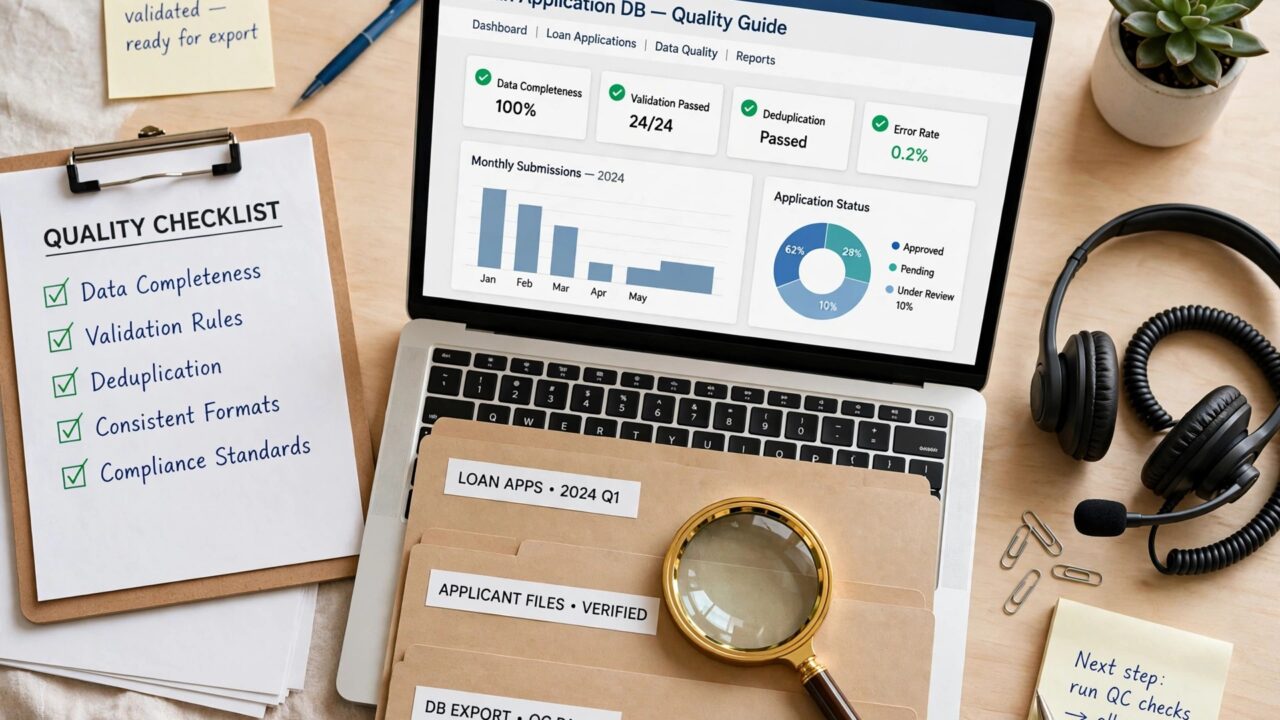
Any team that buys application records faces the same first question: can this data be trusted, and can that trust be shown, not just claimed? This guide sets out a practical way to answer it, by checking freshness, accuracy, permission and proof before money or time is spent. Loan Application DB
Key Takeaways
- Start with quality, not quantity. A compact set of verified, up to date and properly permitted records will serve a team better than a huge mixed file.
- Work through seven checks before you buy: how fresh the labels are, whether records are complete, how duplicates are handled, whether consent is documented, whether categories are right, whether contacts are reachable, and what help comes after delivery.
- Treat warning signs as more important than sales talk. Unclear freshness labels, consent that exists only in vague words, and no sample to inspect are all reasons to pause.
- Test on a small scale first. A limited trial shows, in days, what a brochure cannot show at all.
- Measure value in genuine conversations, not in the size of the file or in counts that were promised.
What a Loan Application DB Is
In simple terms, it is a structured store of application records. A record is created when someone sends in an application through a form or another service channel. It keeps the contact information that person supplied, when the application arrived, what kind of request it is in general terms, where the case stands now, and what permission was given with it. As the case progresses, its stage is brought up to date, so the team can follow each application and see what needs to happen next.
This basic picture matters because it sets the test for everything else. When a supplier cannot say, in plain language, what sits inside each record and how it got there, that supplier has already failed the first check, before any deeper review begins.
Why Evaluation Matters More Than Volume
Size is simple to advertise and simple to count, and that is why it can mislead. A very large file can still waste a week when many phone numbers do not work, many entries repeat each other, and many listed people never agreed to be contacted at all. A poor record takes time twice over, first while someone tries to work it, and then while the miss is reported, recorded and tidied up.
Checking quality first turns that pattern around. A team that reviews before it buys spends its working hours talking with people who requested contact, recall the request and are ready for a conversation. The gain is not only in results. The whole operation becomes steadier, reports become believable, and forecasts start to mean something. Size asks how much was bought. Evaluation asks how much of it was genuine.
Seven Quality Signals to Check
Treat the seven points below as a checklist. A capable supplier will answer each one in a clear way. A weak supplier will answer a couple well and steer away from the rest.
Freshness labels that match reality
Find out what a freshness label means when it is counted in days, and look at receipt times for a sample. Records described as real time should have arrived the same day. Records described as recent should have arrived recently. When the label and the sample do not line up, stop there. A supplier that gets age wrong is likely to get other details wrong as well.
Completeness of every record
Each record needs the basics a consultant must have before a call: contact information, the general kind of request, the present stage, and the time it arrived. When those essentials are missing, consultants are left to guess, and guessing at the opening of a conversation can end trust in seconds.
Duplicate control
Find out how repeat entries are spotted and combined. One person applying twice should leave one record behind, not two files that compete with each other. Strong duplicate handling is hard to notice when it works, and costly when it does not, because two colleagues may end up calling the same person on the same day.
Consent records in writing
Find out what applicants were told and what they agreed to, and read that answer in writing before anything is delivered. Permission should state why contact will happen and through which channel. A record with no written permission behind it is not a useful asset. It is a problem waiting for the first complaint.
Category accuracy
Find out how records are sorted, and check a sample against the label it carries. Sorting decides whether a record lands with the consultant who deals with that subject daily. Careless sorting sends sound records to the wrong desk, where they sit, grow stale and lose their worth.
Contact accuracy
Find out how much of a recent sample actually reached a real person at the first try. This is the check buyers notice earliest, because it shows in the first hour of work. Weak results on a sample point to weak results on the whole file, no matter what the headline figure claims.
Support after delivery
Find out what happens when a record turns out to be wrong. A serious supplier swaps faulty records, explains the fault and improves the next delivery. A supplier that vanishes once payment is made has already shown how the next problem will be treated.
Red Flags That Should Stop a Deal
- Freshness labels that are never defined, or a refusal to show receipt times for a sample.
- Consent talked about only in vague terms, with no written detail on purpose or channel.
- No sample at all, or a sample whose origin cannot be traced.
- Counts that keep rising while you hesitate, or prices that drop sharply as soon as you step back.
- Results promised outright, such as guaranteed clients, by a supplier that sells data and not outcomes.
- No clear way to replace faulty records, fix mistakes or delete records when asked.
One warning sign on its own calls for a straight question. Two together are enough to walk away, even when the price looks tempting. Capable suppliers welcome close questions, because close questions are where their quality becomes visible.
Questions to Ask Before You Order
- What does each freshness label mean in days, and can receipt times be seen on a sample?
- What did each applicant agree to, and is that agreement on record for every entry?
- How are duplicates spotted and combined, and what happens to the combined record?
- How are records sorted by category, and how accurate is that sorting on a recent sample?
- How much of a recent sample reached a real person at the first try?
- What happens when a record is wrong, and how fast is it replaced?
- How long are records held, and how are they removed when the agreed period ends?
Put these questions in writing and keep the replies. Written replies protect everyone involved. They give the buyer a clear standard to measure against, and they give an honest supplier a fair chance to show quality before a larger order is placed.
How to Run a Small Test First
A limited trial is the cheapest quality check on offer, and it runs over days rather than weeks. Settle on a small set of records that carry the same labels and terms the full order would carry. Work that set in exactly the same way the full file would be worked, with the same people and the same follow up routine. Track the things that matter: how many records reached a real person, how many were duplicates, how many were incomplete, and how many raised a permission concern.
Then judge by what you saw, not by enthusiasm. When the trial performs well, grow the order step by step and keep measuring. When it performs poorly, the trial has saved the price of a full order and the weeks that would have gone into explaining it. In either case the trial earns its keep, because it swaps opinion for observation.
What Good Service Looks Like After Delivery
Delivery sits in the middle of the relationship, not at its end. Sound service appears in steady habits: faulty records swapped without argument, stages brought up to date as cases move, questions answered with detail rather than slogans, and regular checks that the data still matches its labels. The supplier treats the buyer team as a partner in quality, not as an audience for claims.
Privacy is part of that habit all the way through. Records stay in a managed system with limited access, contact stays within the permission each applicant gave, records are not passed further than the agreement allows, and records are removed once the agreed holding period ends. A supplier that handles applicant data in this way earns trust from the next applicant who thinks about asking, and that trust is the true value behind every record.
Conclusion
A loan application database earns trust in the same way any source does: by staying fresh, accurate, permitted and open to checking. Run the seven checks, stop at the warning signs, ask your questions in writing and trial before you commit. Follow that routine every time, and the database becomes a reliable source of genuine conversations with people who asked for them. That is the full standard, and it is also the simplest one: trust only data that can show, at each stage, that it deserves to be trusted.
Frequently Asked Questions
What is a Loan Application DB in simple words?
It is a structured store of application records. A record appears when someone submits an application, and it keeps the contact information they supplied, when it arrived, what kind of request it is in general terms, where it stands now and what permission came with it, so a team can follow an application from arrival to response in an orderly way.
What is the single most important quality signal?
Freshness labels that agree with receipt times on a sample. When label and sample agree, the supplier is likely straight about the rest. When they disagree, other claims should not get the benefit of the doubt, because age is the simplest signal to check and the simplest to misstate.
How large should a test order be?
Big enough to measure, small enough to drop. A limited set worked in the same way the full file would be worked gives a fair view of reach, duplicates, completeness and permission concerns. Size matters less than the discipline of working the set properly and recording the outcome honestly.
Can a database guarantee more clients?
No. Sound data only ensures that a team spends its time on genuine, relevant and permitted inquiries from people who asked. Turning those inquiries into clients rests on the speed, knowledge and honesty of the service itself. A supplier that promises clients instead of data should be treated with great care.
What should happen to records that are wrong?
They should be swapped quickly, with an explanation of the fault and a correction to the next delivery. Faulty records happen in any large system. What sets good suppliers apart from poor ones is not a total absence of mistakes, but how fast and how honestly corrections are made.